
Middleware for railway
Connect the systems behind tomorrow’s rail.
Bring perception, onboard computing and railway applications together with real-time DDS communication, and a product path for safety-critical requirements.
Connect sensors and applications.
Build around your assurance needs.
Evolve systems across suppliers.
Conceptual view. Safety boundaries and delivery requirements are defined by your system architecture.
What your railway system needs
Move the data.
Keep the architecture under control.
Railway software brings together different data rates, computing platforms and assurance requirements. Design the communication around each part of the system.

High-volume sensor data
Deliver sensor streams and processed information to the applications that need them, with communication behavior tuned to latency, throughput and resource constraints.

Safety-critical communication
Define the safety boundary, communication requirements and assurance evidence from the start. Choose middleware as part of the complete system safety architecture.
System interoperability
Connect independently developed components through shared data types and DDS interfaces, reducing tight coupling between applications and suppliers.
eProsima technology in railway
Deutsche Bahn.
From perception to safety-critical computing.
Our work with Deutsche Bahn spans two publicly documented projects: Fast DDS and ROS 2 in Sensors4Rail, followed by Safe DDS architecture work in AutomatedTrain.
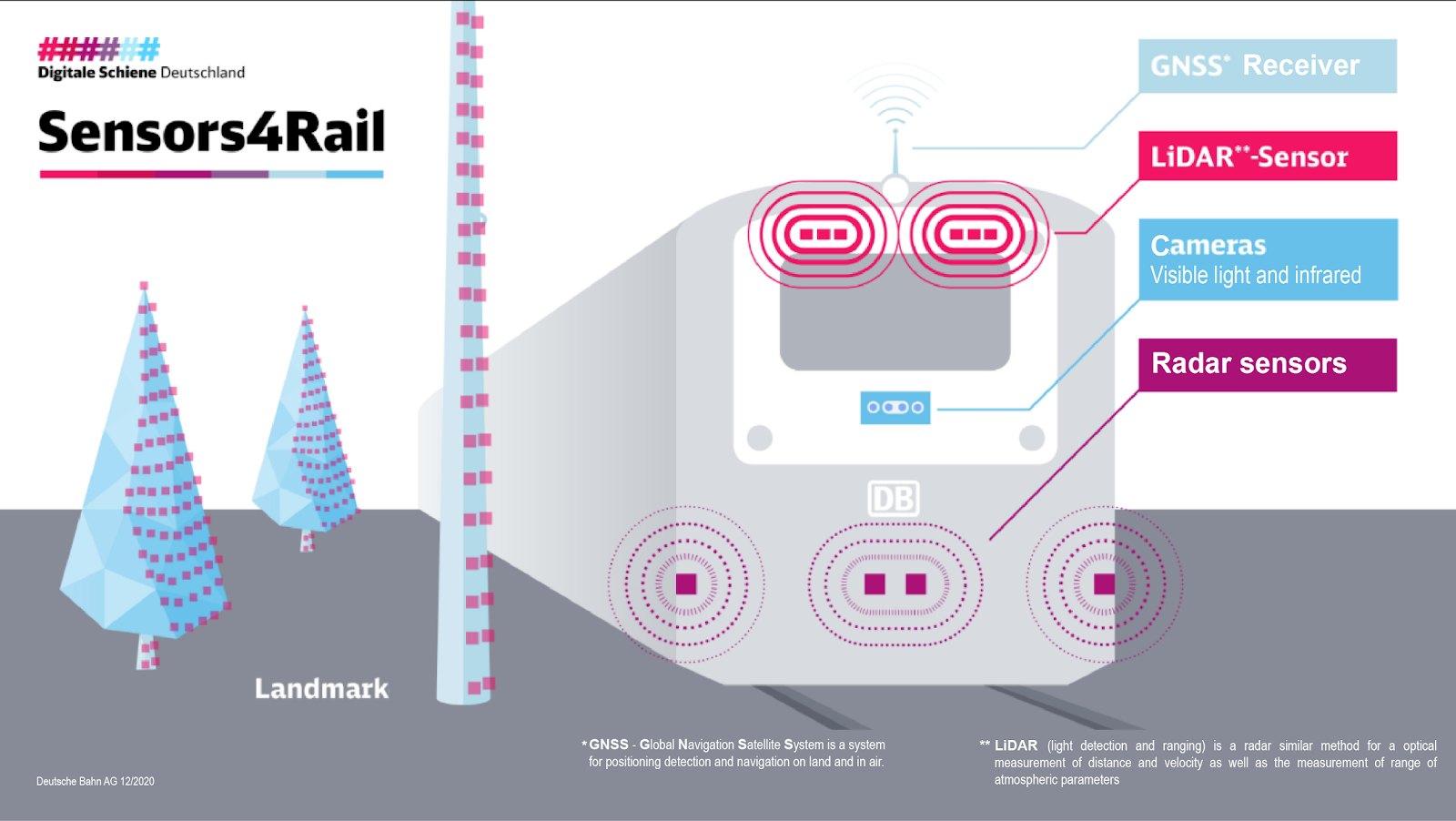
01 · SENSORS4RAIL · 2021
Connecting perception and localization
Deutsche Bahn selected Fast DDS for real-time data exchange in its ROS 2-based Sensors4Rail pilot. Discovery Server helped connect the distributed applications supporting sensor-based perception and localization.
02 · AUTOMATEDTRAIN · ANNOUNCED 2026
Advancing safety-critical onboard computing
Building on that relationship, eProsima contributes Safe DDS to a concept study and prototypical demonstration for AutomatedTrain’s safe onboard computing platform, with separate safety-critical and non-safety-critical domains.
Images from the linked eProsima announcements. Sensors4Rail illustration: Deutsche Bahn AG, 12/2020. AutomatedTrain is a research and development project; this contribution is not a claim of a certified, deployed railway system. Explore the official project.
Our previous railway engagements also include Fortescue and Siemens, among others.
Railway applications
One data foundation.
Different application needs.
From sensing to diagnostics, DDS supports a modular approach to railway software. Connect data producers and consumers without hard-wiring every application to every device.
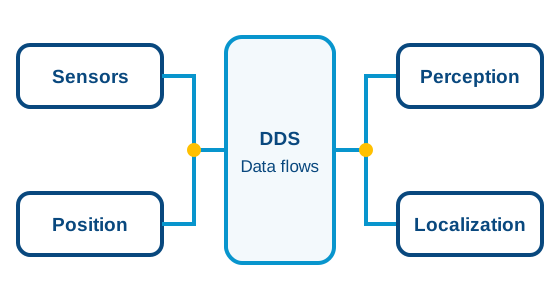
Bring the railway environment into software.
Connect sensor streams, localization results and perception applications through well-defined data interfaces. Tune delivery to the needs of each consumer rather than treating every stream alike.
- Distribute sensor data and processed results.
- Configure DDS Quality of Service for each data flow.
- Integrate native DDS and ROS 2 applications.
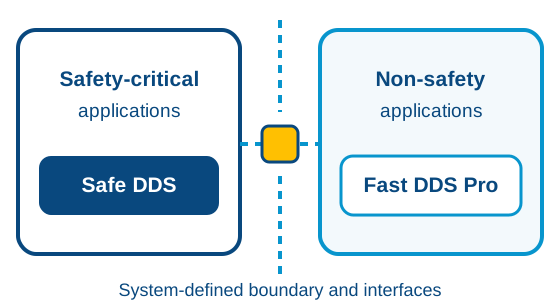
Separate the domains. Define the interfaces.
Design the exchange between onboard applications around their timing, resource and assurance requirements. Establish safety boundaries and evaluate the middleware within the complete computing architecture.
- Plan safety-critical and non-safety-critical domains.
- Define data contracts between onboard components.
- Assess Safe DDS against your project’s assurance needs.
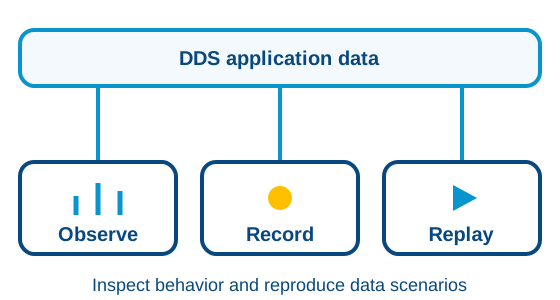
Understand what happened. Reproduce the data.
Give integration and test teams visibility into distributed communication. Inspect DDS entities and data, record relevant scenarios and replay them to investigate application behavior.
- Observe communication with DDS Monitor Pro.
- Record and replay DDS application data.
- Use captured scenarios in integration and regression tests.
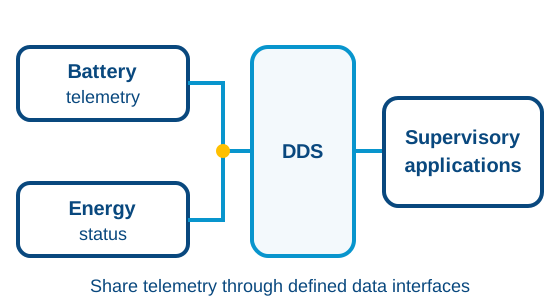
Connect the information behind electrification.
Use shared data interfaces to integrate energy-management applications, battery telemetry and vehicle monitoring. The communication architecture can evolve as subsystems and suppliers change.
- Exchange battery and energy-system telemetry.
- Connect supervisory and diagnostic applications.
- Integrate subsystem interfaces through scoped engineering.
Open architectures for railway interoperability
Build on open interfaces.
Plan for system-level assurance.
Open railway architectures seek to separate applications from tightly coupled platforms. DDS is relevant to that conversation, alongside the computing platform, network and safety requirements.
OCORA & safe computing
The Open CCS On-board Reference Architecture explores modular onboard systems. Its public material includes a DDS reference implementation for safe computing platform messaging.
DDS-based communication
Shared data types and configurable delivery policies give applications a common communication foundation. Interface definitions and system-level integration remain essential.

Ethernet & TSN
DDS provides application-level data exchange over the network. Where TSN is part of the railway architecture, its scheduling and the DDS delivery configuration need to be designed together.
Architecture references are not product-conformance claims. DDS alone does not guarantee deterministic network timing or establish railway safety certification.
Choose your railway foundation
The right middleware.
For each part of the train.
Start with the requirements of each application domain. Combine safety-focused middleware, advanced product capabilities and open-source development where appropriate.
COMMERCIAL · ASIL D

For embedded railway applications that need native DDS connectivity, efficient resource use and safety-focused deliverables to support their system-level assurance work.
- Native DDS for embedded computing platforms.
- Safety-focused development and product evidence.
- Professional tools and subscription product support.
Commercial

For distributed railway applications that need advanced communication features, professional DDS tools and subscription product support through development and deployment.
- Advanced networking and discovery capabilities.
- Professional monitoring and development tools.
- Product support through a commercial subscription.
Open source

For railway teams building with open-source DDS, public documentation and community resources, with a commercial product path as application requirements evolve.
- Open-source DDS implementation.
- Native DDS and ROS 2 integration.
- Public documentation and community resources.
Safe DDS’s ISO 26262 ASIL D certification has a defined automotive scope. Railway assurance and certification must be assessed against the applicable project standards; product certification does not automatically certify a railway system.
Engineering your railway architecture
Turn communication requirements into an integration plan.
Work with eProsima on the architecture decisions, interfaces and measurements that matter to your railway project.
Architecture studies
Review data flows, QoS policies, computing constraints and domain boundaries before committing to the implementation.
Integration & migration
Connect existing applications and subsystem interfaces, or plan a transition to a modular DDS-based architecture.
Performance evaluation
Measure communication behavior under representative workloads and use the results to guide configuration and design.
Consulting, architecture studies and custom engineering are scoped separately from subscription product support.
Talk to a middleware expert
Let’s discuss your railway project.
Tell us what you need to connect and which performance, integration or assurance requirements shape your architecture. We can help identify the right product path or a focused engineering engagement.
Sensor data and onboard computing.
Embedded and safety-critical communication.
Open interfaces and subsystem integration.
Product subscriptions and engineering services.