

For extremely constrained devices
Bring tiny devices into the DDS Global Data Space.
Use a lightweight DDS-XRCE Client and an Agent bridge when a microcontroller or FPGA is too constrained to host a complete DDS implementation.
Documented simple publisher/subscriber client configuration.
UDP, TCP, Serial, CAN FD and custom transports.
Open-source Client and Agent implementation.
OPEN SOURCE · SPECIALIZED PATH Micro XRCE-DDS is deliberately narrow.
It solves the edge case where the target is extremely constrained. For regular embedded products, deterministic systems and safety-critical applications, evaluate Safe DDS first.
How the architecture works
A small Client. An Agent bridge. One DDS data space.
The XRCE Client does not participate in DDS directly. It sends DDS-XRCE operations to an Agent, which creates and manages DDS entities on its behalf.
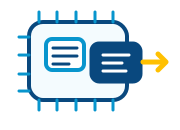
DEVICERun the XRCE Client
Compile a lightweight C client with only the profiles and transport required by the target.
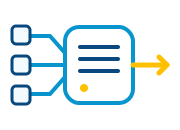
BRIDGEConnect to the Agent
The Agent maintains Client sessions and translates XRCE operations into DDS entities and data exchanges.
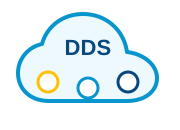
DATA SPACEExchange with DDS
Fast DDS participants communicate with the entities represented by the Agent in the DDS Global Data Space.
Core capabilities
Use only when the device constraints demand it.
Micro XRCE-DDS is optimized around a compact Client, flexible transports and an Agent-mediated path to DDS.
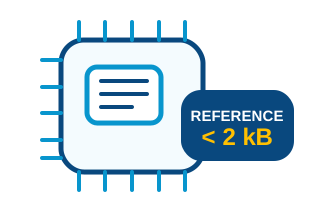
Fit extremely constrained targets
Run a small C client on devices that cannot host a complete DDS implementation. A simple publisher/subscriber can operate with less than 2 kB of RAM in the documented reference configuration.
- Small, portable C implementation
- Static-memory operation
- Footprint shaped for the target
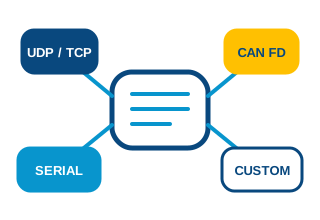
Choose the transport that fits the device
Use UDP, TCP, Serial, CAN FD or a custom packet- or stream-oriented transport according to the interfaces available on the target.
- UDP and TCP
- Serial and CAN FD
- Custom packet or stream transports
Select only what you need
Enable or remove transport, discovery, framing, multithread and shared-memory profiles at compile time to shape the client for the target.
- Compile-time selection
- Remove unused capabilities
- Create a target-specific client
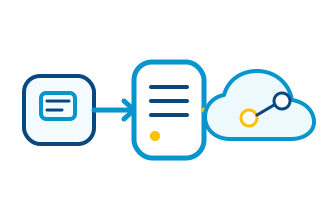
Bridge constrained devices into DDS
Let the Agent create DDS entities and exchange data with the DDS Global Data Space on behalf of each XRCE Client.
- XRCE session management
- DDS entities represented by the Agent
- Interoperability with DDS participants
Choose the embedded path
Micro XRCE-DDS or Safe DDS?
The decision is architectural, not simply a matter of footprint. Start with the target constraints, the required runtime model and the product lifecycle.
Choose XRCE when every kilobyte matters.
- The target genuinely cannot host a complete DDS implementation
- An external Agent is acceptable in the system architecture
- You need UDP, TCP, Serial, CAN FD or a custom constrained link
- You will own integration, validation and lifecycle management

Choose Safe DDS for a professional embedded product.
- You need direct DDS / RTPS participation without an Agent
- Predictable real-time behavior and memory control matter
- You want an independent implementation with no external dependencies
- You need ISO 26262 ASIL D evidence or a safety-oriented lifecycle
| Open source Micro XRCE-DDS | Commercial · Asil D Safe DDS |
|---|---|---|
Primary target | Extremely constrained MCUs and FPGAs | Embedded, real-time and safety-critical systems |
Architecture | Lightweight XRCE Client plus external Agent | Independent DDS / RTPS implementation |
DDS participation | The Agent acts on behalf of the Client | Direct participation in the DDS Global Data Space |
Footprint strategy | Minimum XRCE client footprint through compile-time profiles | Controlled embedded footprint with deterministic behavior as a core design priority |
Runtime dependency | Requires an Agent to reach the DDS network | No external dependencies |
Functional safety | Not safety certified | ISO 26262 ASIL D certified |
Best fit | When the device genuinely cannot host a DDS implementation | Professional embedded products and systems with lifecycle, real-time or safety requirements |
Developer resources
Start with the supported architecture.
Use the current documentation for architecture, installation, profiles, transports and examples.

Documentation
Architecture, installation, Client API, Agent configuration, transports and examples.

XRCE Client
The lightweight C implementation intended for the constrained target.
XRCE Agent
The bridge that represents XRCE Clients in the DDS Global Data Space.
Architecture first
Is the target truly XRCE-constrained?
Tell us about the processor, memory, operating system, transport and safety requirements. We will help determine whether Micro XRCE-DDS or Safe DDS is the stronger long-term architecture.
Target footprint and memory model.
Agent dependency and network topology.
Real-time and safety requirements.
Migration and product lifecycle.